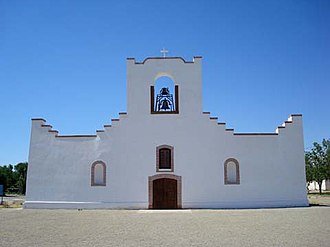
Another business trip, another adventure. I am fortunate to have a career that takes me to interesting places and to be at a stage of life where I can add some extra time to enjoy. This time Chrissy and I were off to El Paso, Texas – a place we likely wouldn’t have chosen on our own, but we’re glad work gave us this opportunity.
For centuries the Rio Grande was just a natural feature cutting through the desert landscape. For Indigenous peoples, Spanish colonizers, Old Mexicans, New Mexicans, and Texicans it was a source of water and a challenge to cross, but not a divider of people. If anything, it connected them. People came to the river and settled on both sides. People crossed regularly like I cross the Merrimack River in Manchester today.
But as people do, they started struggling for control of the land, ultimately resulting in the Mexican-American War and the Treaty of Guadalupe Hidalgo in February 1848. The treaty established the Rio Grande as the border between the United States and Mexico. Suddenly people on either side of this shared resource found themselves in different countries.
When I was growing up my family, one set of grandparents, and some cousins lived in Sarasota, Florida while my other set of grandparents and some more cousins lived across the county line in Bradenton. It would be like all of us suddenly being in two different countries. Common language, culture, and family now in two separate nations.
Fortunately, family and culture are strong. Despite efforts to separate and divide, the rich regional culture, language, and food (thank God, the food!) persisted on both sides of the new border. Among the cultural influences were a series of Catholic missions, three of which are now on the U.S. side of the river and can be visited on the El Paso Mission Trail. Chrissy and I followed the trail during our visit and had a wonderful chat with a volunteer at the Socorro Mission. Her family has been in the region forever. Literally forever, at least in human terms. They didn’t settle in the Rio Grande Valley from somewhere else – they have been here for as long as anyone remembers. And she explained that in 1849 – the year after the border was established – a flood changed the course of the river. The river which once flowed to the north of the mission now flowed to the south, moving the mission from Mexico to the United States. She said, “So I didn’t cross the river, the river crossed me”. She, of course, was born in the US, but her family did not become American by birth or by choice but by the negotiation of a treaty and the meanderings of a flood-swollen river. She spoke with no bitterness but simply made the point that her connection to the land and the people is stronger than any government or border.
Today El Paso sits on one side of the river and Ciudad Juarez on the other, separated not only by a mostly dry riverbed but also by a 20-foot tall fence topped with razor wire. An ugly scar on the landscape separating people and families. People like the lady at Socorro who is descended from Americans because the river meandered south, but has just as as many roots on the other side. People like Chris whom I worked with while I was there. Chris crosses the border at least once a week to spend time with his family members who grew up and live in Juarez. Like I used to go to Bradenton every week for Sunday dinner and time with my grandparents and cousins.
I know nations need to control borders and immigration. Countries need to know who is coming and going. But as we drove alongside that fence on Texas 375, looking across to people driving on a similar road on the other side, it made me sad. Sad for the common region, common culture, and families separated by that fence. But sadness wasn’t the only thing I felt.
While the fence made me sad, something else made me mad. I couldn’t help noticing that around El Paso Chrissy and I were a minority. We are Caucasian and don’t speak Spanish. Most people around El Paso are bronze or brown and their ancestors have inhabited this now-American soil much, much longer than my ancestors from Germany and Holland and Ireland and wherever else they came from. Most of those people are ancestrally connected to this American soil more than I ever will be. Yet today they are subject to being harassed, asked for “papers”, or being detained simply for their appearance, language, or accent. Maybe not at home in El Paso, but if they travel to other parts of the country, their country, they do so with anxiety. American citizens are carrying their passports and birth certificates out of fear. That, my fellow Americans, makes me mad.
I wish I had a feel-good ending to this, but it is still being written. I have learned that nothing is permanent, and I have hope that compassion will return. Americans are a compassionate people. Even among those who believe in strong borders and immigration enforcement, most don’t condone cruelty and hardworking, law-abiding people living in fear. Cruelty may reign for a time, but it will not last.
And on a happier note, if you get the chance to go to El Paso – go! Enjoy the fantastic food, unique culture, and wonderful people along the Rio Grande.
 Where Are We Going Now?