Chrissy and I recently returned from a trip to Nova Scotia and Prince Edward Island. We explored Halifax and the coast nearby, spent a couple of days on Cape Breton Island, and a day and a half on PEI. It was a week-long trip that could have easily been a month.
I was last in Canada about a year ago. Before that, my Canadian experiences consisted of a small handful of one- or two-day work trips, a quick trip to Victoria during a Seattle vacation many years ago, and a week canoeing in Quetico with my son’s Boy Scout troop – a trip where we saw no other people.
But last year I spent a week working on a project near Vancouver. I was out in the community, working alongside my firm’s local partners and testing infrastructure in residential and commercial areas. It was my first experience being immersed in Canada for several days in a row. The land was beautiful and the people were wonderful. After living in Wisconsin for several years, I got used to Midwest Nice. But Canadian Nice is Midwest Nice turned up to 11, like Spinal Tap’s amplifier.
The strongest impression I had of Canada on that trip, though, was diversity. The three people I worked with were of Chinese, Korean, and Caucasian descent. The neighborhoods we worked in were populated by people of every race and nationality imaginable. When I ran on the trail near my hotel, I encountered dress, skin color, and accents from all over the world. And the food! Restaurants serving cuisine from every corner of the planet.
What really stood out to me was the mix of people and cultures. Everyone sharing the same neighborhoods and getting along with tolerance, curiosity, and respect.
Fast forward a year and I find myself on vacation for a week on the other side of the country and continent, but the feeling was very much the same.
Our trip started with a couple of days in Halifax. As we walked around the city, the people represented a myriad of backgrounds and cultures, all side by side and seemingly getting along just fine.
The waterfront in Halifax is a great place to spend a day, walking the boardwalk and visiting the stores, restaurants, attractions, and ice cream shops (especially the ice cream shops) along the harbor. As luck would have it, we were there on a Sunday when the weekend Seaport Farmers’ Market at Pier 23 was open.
When we entered the large market building, we were greeted by the sights, sounds, and smells of a dozen or more cultures. There was little produce being sold, but dozens of booths with people preparing everything from tamales to onigiri to pierogies. There were foods, pastries, and crafts from every continent and region of the world. All of it was there not for some cultural festival or special occasion, but because it was Sunday. They are there every Saturday and Sunday, selling their wares to locals and tourists alike. It was our first stop of the day, and it would set the tone for what came next.
As we left the market with our senses stimulated, our next stop was the Canadian Museum of Immigration at Pier 21.
Halifax was the most common point of immigration in Canada until air travel shifted the trend toward larger cities like Toronto and Montreal. From 1928 to 1971, immigrants were received and processed at Pier 21, a facility that served a purpose much like Ellis Island in the United States. The museum has a wonderful collection of photographs, artifacts, and displays telling the story not only of Pier 21, but of immigration in Canada. And that history isn’t all pretty.
For many years Canada, like most countries, admitted people who could contribute to Canadian society. But it also favored some nationalities, races, and religions over others. The museum doesn’t hide or downplay that history. It presents it honestly, alongside an acknowledgment that those policies were wrong.
Beginning in the late 1960’s, Canada established a points-based immigration system that emphasized skills and other qualifications rather than race, religion, or ethnicity. The system may not be perfect, but it was a significant improvement over what came before. And more than 50 years later, it has contributed to the beautiful diversity I have observed and enjoyed now twice in Canada.
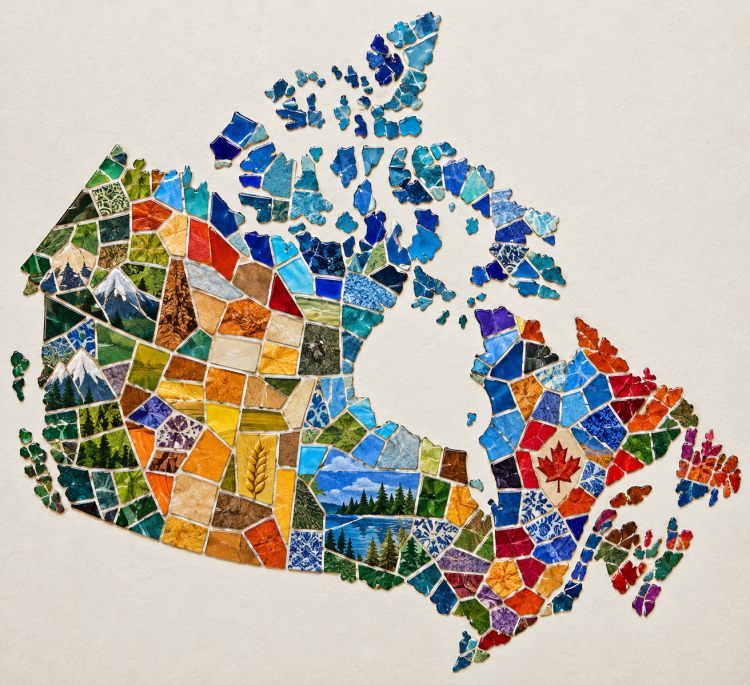
My son-in-law said he had heard the United States described as a melting pot, where different cultures are intended to blend into one delicious soup. Canada, on the other hand, was described as a mosaic, where people retain their cultural identities and together create a beautiful picture. Both philosophies have their merits, but with pieces of different colors and different shapes, none losing their identity, and all contributing to the whole, the mosaic creates a beautiful picture indeed, eh?

